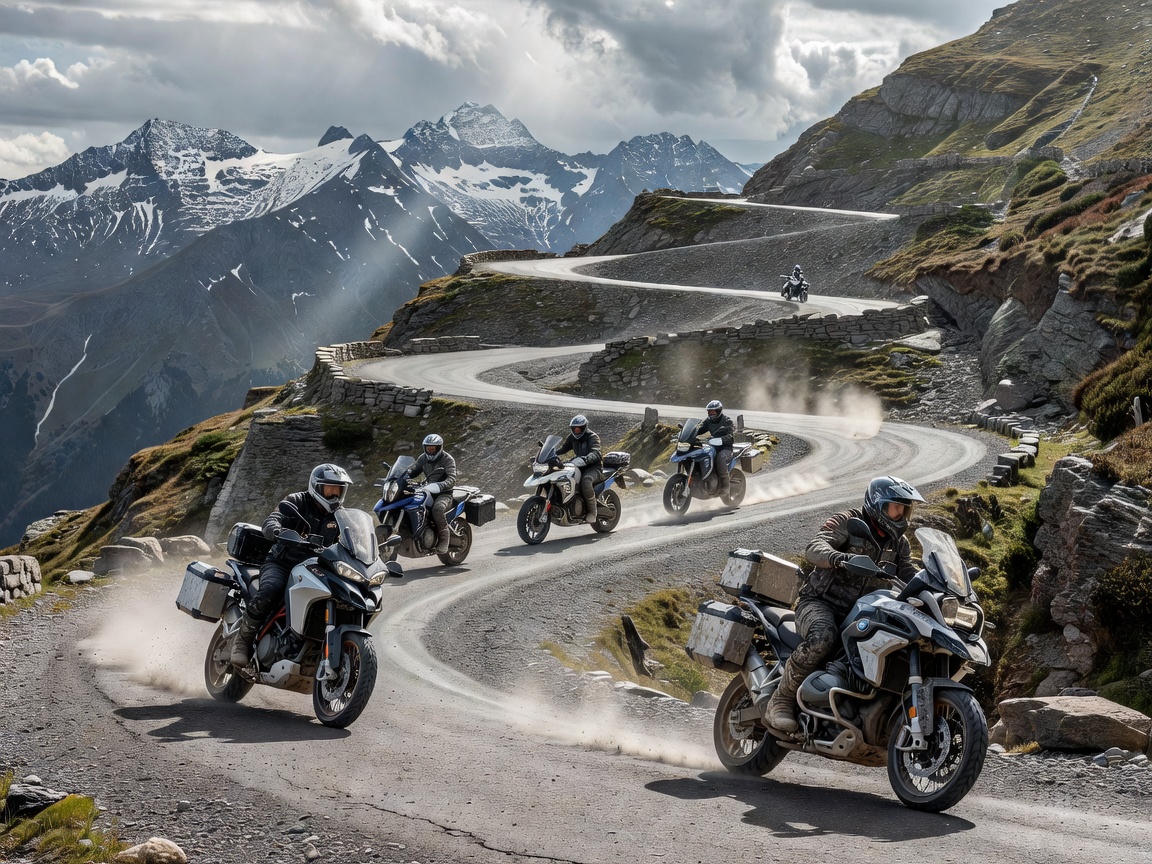
The Tactical Overview
The Alps form a colossal natural barrier across Europe, stretching from France in the west to Slovenia in the east. For the motorcyclist, this mountain range presents a dense concentration of legendary paved roads, including the Stelvio Pass in Italy, the Grossglockner High Alpine Road in Austria, and the Col de l'Iseran in France. Riding the Alps is not about outright speed; it is about rhythm, cornering precision, and stamina over days of constant elevation changes.
While the roads are generally well-paved, the sheer complexity of the route—combining blind corners, steep gradients, and sharing the road with cyclists and touring buses—demands intense mental focus. A typical circuit spanning France, Switzerland, Italy, and Austria will cover roughly 1,500 to 2,500 kilometers depending on the chosen waypoints.
Adventure tourers (e.g., 800cc–1250cc) or sport-touring machines. Upright seating provides better visibility through hairpins. Wide handlebars offer superior leverage for tight turns.
90/10 or 100% street-biased touring tires with dual-compound technology. You need hard centers for the transit stages and soft shoulders for maximum grip on cold alpine tarmac.
Mid-June to early September. High passes are frequently closed due to snow outside this window. Even in August, freezing temperatures at altitude are common.
High thermal capacity is essential. Upgraded brake fluid (DOT 4 or 5.1) and high-quality sintered pads are mandatory to prevent brake fade on long, steep descents.
Riding the Hairpins (Tornanti)
The defining feature of alpine riding is the switchback, known in Italy as a tornante. Taking these uphill requires slipping the clutch in first or second gear, keeping engine RPM high enough to prevent stalling if the gradient steepens mid-corner. Downhill switchbacks require trailing the rear brake to stabilize the chassis while keeping your eyes pointed entirely toward the exit, which is often severely off-camber.
It is crucial to note that on right-hand climbing hairpins (in countries that drive on the right), visibility is severely limited. Standard practice dictates taking a wider entry to maximize sightlines, assuming a bus or motorhome may be crossing the center line on their descent.
Weather Logistics and Gear
The concept of "summer" is relative in the Alps. You can begin a valley ascent in 30°C (86°F) heat and crest the pass at 2°C (35°F) in driving sleet. Layering is not optional; it is a critical safety requirement. Base layers that wick moisture are vital because sweating in the hot valleys will lead to rapid hypothermia when the temperature drops at 2,500 meters of elevation.
Waterproofs should be kept in a tank bag or top box for immediate deployment. Do not wait for heavy rain; pull over at the first sign of a squall. The road surface, particularly in shaded forest sections, can remain damp and treacherous long after a storm has passed.
Pros and Cons of the Alps Circuit
Advantages
- Unparalleled infrastructure: Plentiful fuel stations, excellent roadside cafes, and motorcycle-friendly hotels.
- Immaculate tarmac on the primary passes.
- Incredible scenery and historical waypoints.
Disadvantages
- Extreme congestion during July and August.
- Strict speed enforcement and heavy fines, particularly in Switzerland.
- High financial cost for accommodation, fuel, and toll roads/pass tickets.
Conclusion
The Alps Circuit remains a rite of passage. It demands respect, a well-maintained machine, and an adaptable mindset. Focus on fluid inputs, manage your braking temperatures, and dress for three seasons in a single day. Execute it correctly, and it is arguably the finest paved riding experience available on earth.